Reflective Entry 4 - My Inquiry So Far.
Another interesting week this week as I have really been challenged by the comments last week. My own cultural lens plays a part in all my interactions and I’d like to think I critically reflect on my actions as an educator, both in-action and on-action. Using Gibbs’ Reflective Cycle (1988) (see figure) as a guide, this week I am going to examine an unexpected reaction from my target learners in the first week of taking action.
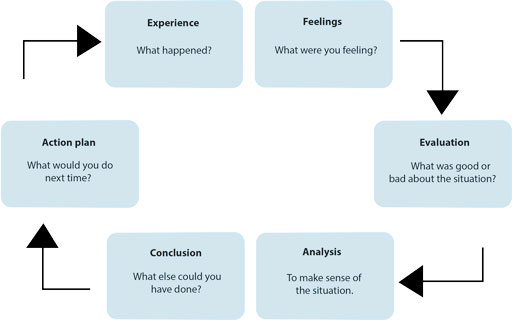 Figure 1.
What Happened?
For those of you who haven't seen my action plan, one of the initial steps of taking action was to give the children a choice in many areas of self-management for writing. After meeting with me, in an attempt to be sure the target students were ready to head off and get started, I gave them a sheet to quickly fill out. What I had not anticipated was how difficult it would be for my 7 and 8-year-olds to cope with being given a choice! Their reactions to this varied from doing nothing, watching someone else in the group, swapping highlighter colours (repeatedly), and looking at me for more detail. They were not used to this and were looking for the right answer to the choices! One child quickly filled in the form and proudly showed me his lovely highlighting and then said: “What do I do now?”
And there it was! The hiccup in my otherwise brilliant action plan.
How Did It Make Me Feel? What Was I Thinking?
Quickly I snapped back to professional mode again and thought “uh-oh, I need to rethink this and quickly. I wondered how many others were the same - had not actually understood much of what I had said. Using reflection in action (Schon, 1993) strategies, I decided I needed to find out more. With a group of six 7 and 8 years olds looking at me expectantly with all ears listening as they waited for me to tell them EXACTLY WHAT TO DO, it was quickly apparent that it wasn’t just one little lad who had missed the point.
What Sense Did I Make From This?
From this situation, I had to do some serious re-thinking. While the plan itself was robust and step-by-step; these were steps for me and not them. The very essence of this inquiry was taking step by step actions to help the students gain agency and yet had totally bypassed their own voice as to what steps were needed - by them, not me.
In response to new learning regarding the different ways of effective reflection I used employed the fourth level of Zeichner and Liston's (cited in Finlay, 2008, p.4) five levels of reflection. I did some research about student choice and discovered an article from Kohn (1993) that resonated with my existing ideas. Kohn (1993) identifies three ways students resist choice; refusing, parroting and testing. These children didn’t test me, they avoided making a choice, and they were hoping for some more information so they could parrot what they heard. This was really worrying to me as a teacher and as I read his paper, I became dismayed at how little choice I had given them previously. It dawned on me, that the reaction I was seeing now, was because what I was doing was simply a bridge too far from what the past looked like.

What Could I Do Differently?
I know that I can’t undo the past, and at that moment, I had to fold back and start with something simple. The task I was asking them to do, was too big and never going to work. So, I could have introduced the choices one at a time, allowing them to just make one choice, rather than several. That was what I did, at that moment. The other thing that I have since thought about, was to actually make the decision for them, e.g. today we are all going to work with a buddy, tomorrow we are all going to work alone, and on the third day, we can decide for ourselves because we will have had the experiences to compare. I’m not sure if this would work better, but this way, I feel the children would have had something to think about while they were doing both the options. We could also have brainstormed what both of these options meant and the reasons we were doing them - was it for increased output, or was it for a higher quality of work, etc. In the original disposition rubric I completed on the students for initial data collection, I knew what I wanted, increased agency that resulted in both of these, but did I make it clear to the students? Probably not. Actually No.

What Did I Learn?
Next time, I make an action plan, I need to involve the students in this part of the inquiry. Making the
plan without them is not giving them agency - the irony of this is not lost. I am trying to increase agency by ‘doing something to them’ not by ‘doing something with them’. However, I can’t go backward, so going forward, I am going to make some changes to my inquiry. The action plan originally was about supporting the children by developing visible learning pathways and the intention was the academic learning goal. I now think the pathway we need to explore further is that of choices, what we hope to achieve and why. Next week, this action will take place. We will talk about the different ways we learn, and which way they think they like best. We will also talk about evidence and to do this, we need to unpack what evidence will look like for each of them. I need to move away from assumptions that they know what ‘better’ writing looks like and that they know a choice will have no hidden agenda. The other thing that I know I will do in the future (not limited to inquiries) is promote choice in my classroom right from the beginning of the year.

References:
Finlay, L. (2009). Reflecting on reflective practice. Practice-based Professional Learning Centre, Open University. Retrieved from http://www.open.ac.uk/opencetl/sites/www.open.ac.uk.opencetl/files/files/ecms/web-content/Finlay-(2008)-Reflecting-on-reflective-practice-PBPL-paper-52.pdf
Kohn, A. (1993). Choices for Students: Why and How to Let Students Decide. Phi Delta Kappin. Downloaded from: https://www.alfiekohn.org/article/choices-children/ 30/6/19.


I think your revelation that you were trying to increase student agency by 'doing' something to them rather than with them was interesting. How could you set something up like this along side them? They do have to know what their options are to be able to choose, but I feel like at some point they need to be pushed a bit. To stop expecting that they will be told exactly what to do and how to do it.
ReplyDeleteThanks Hester. It certainly was interesting. They do certainly need to know the options, however
ReplyDeletethe reading from Khon (1993) definitely highlighted the dichotomy between students choosing what to learn and the need to teach within the curriculum. However to set something like this up alongside them will never be totally free given the restraints we (both teachers and students) face. I guess that is a big part of the challenge I am facing - finding the right balance and scaffolding the support appropriately. Something to think about for sure.
It's the area that I need to concentrate on too I think. As we know, giving students control does not mean giving them the freedom to do whatever they want, however they want. They need a clear structure through which to move and act in an informed way. I'ts creating and providing this structure that is proving difficult to me. Some things have worked well such as rubrics, but it is also a lot of work for me as a teacher preparing these resources beforehand and planning out how to give students choice and control. It's more work outside of the classroom and less during the learning block.
ReplyDeleteHester, have you had any more thoughts on how to balance this workload to provide opportunities that we want to offer them? I was thinking that the setting up, while time consuming is something that can be used over again (like visible learning walls). I also was thinking about the leadership aspect we could take on here with promotion of these ideas amongst our colleagues - therefore sharing the workload across a team? What do you think?
Delete